When the S#*! Gets Real
By Amy Nelson
It’s one thing to craft brilliant decentralized wastewater treatment designs utilizing constructed wetlands. It’s quite another to operate and maintain these systems to achieve optimal performance. For some practical advice, we asked Biohabitats engineering technicians Olin Christy, Cody Smout, & Jake Neilson. They not only help design decentralized wastewater treatment and reuse systems of all scales and sizes; they are also responsible for ensuring Biohabitats-designed regenerative infrastructure is built correctly, commissioned completely, and started up smoothly. They also train the facility staff and operators in how to operate and maintain the system for long-term success. We asked them to share some wisdom for anyone considering developing an onsite wastewater system with constructed wetlands. Here are five guiding principles they shared.
Consider all passive options – gravity is free
Let’s start with the low hanging fruit. Crafting systems that are simple to maintain and easy to operate is a good foundation for any decentralized wastewater system. Infrastructure with less electrical demand and fewer moving parts allows operators and facility staff to focus attention and efforts elsewhere.
Gravity is free, so utilizing it when possible can be advantageous. The fewer pumps there are in a system, the less maintenance and equipment replacement costs are. Typically, gravity influent to a constructed wetland should have a minimum of four feet of hydraulic head, so that it can push through the inlet header into the gravel of the wetland. Another passive solution is to align symbiotic infrastructure. The PAE Living Building in Portland, OR, for example designed their hot water system next to their server room. Their hot water heat pumps pull heat out of the room’s air, which kept the computer servers cool and made heating water more efficient. Early interdisciplinary design meetings should explore this beneficial system relationship potential.
Design with operators in mind.
Put yourself in the operator’s shoes… and all their required spaces. Things look different on paper than they do in real life, and the mechanical room for an onsite wastewater treatment/reuse system is a perfect example. It may be easy to look at a plan and think you‘re providing enough space for an operator to comfortably run and maintain your system, but this usually requires more space than you think.
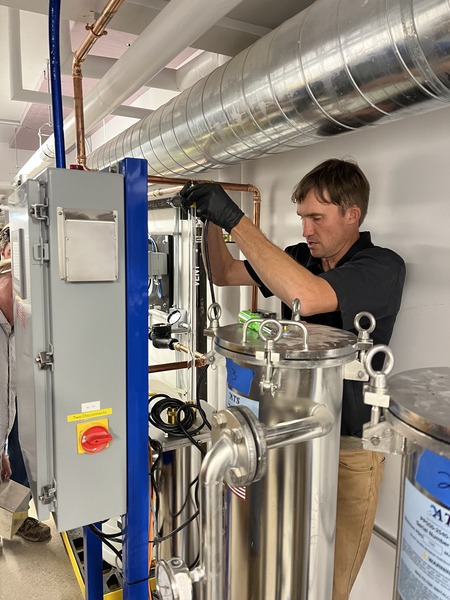
“There may be a meter that the operator has to read,” says Olin, “but he or she has to get up on a ladder and hang sideways off of a pipe in order to see it.” Often multiple building systems are co-located in the same space, requiring the design team to consider how each system may affect operations of the other. If the operator needs to spend significant time in an area, ensure that space is climate-controlled and isn’t excessively noisy. “One building’s mechanical systems were so loud that the wastewater operator couldn’t hear his phone ring over the sound of neighboring equipment,” said Olin.
Be reasonable about what can fit in a riser or splice box. “I’ve encountered systems with six pumps crammed into a 30” diameter riser. This made it very difficult to remove and service pumps,” said Jake. “It is important to provide isolation valves in the right places to remove pumps and flow meters.
Because operators are typically contracted after the system is built, the potential of including them early in the design process is challenging. Good designers will think through all the maintenance tasks needed, as well as steps required for permit compliance to ensure adequate space is provided.
Establish mutual trust and respect between owner, contractor, operator, and engineer.
Everyone involved in the construction of a decentralized wastewater system has valuable knowledge. Owners may have the best site understanding, the contractors know how to produce quality construction, the operators will have maintenance task insight… and the engineers need to have the ability to gain this wisdom to design an effective system. Providing opportunity to communicate with all of these critical disciplines is key to crafting an optimum system.
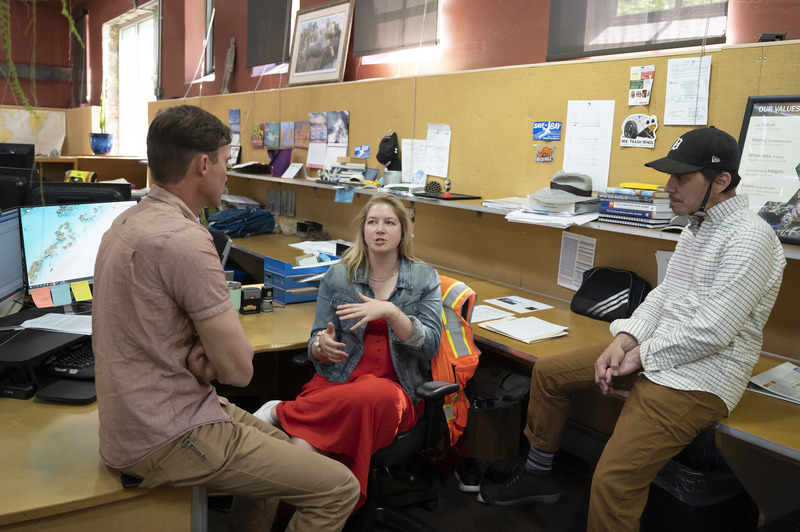
There are several ways to improve understanding and share insight. One of the best is to include a contractor and operator in the design/permitting process. This can happen with periodic design review, permit review, and preconstruction meetings.
“We don’t go into these meetings saying, ‘This is our design, this is what it is supposed to do, and this is how you are going to build it,’” says Olin. “Instead, we go in with a team attitude and say, ‘Here are the design documents. What do you think? Do you see any potential issues, or any ways to make this better?’”
And yes, there will be issues that come up during construction and if trust and understanding is held between all parties, resolution will be simpler and create a better more robust system. We also know that not every contractor or operator is familiar with constructed wetlands, so we need to allow for time to demystify nature-based infrastructure for even the most competent personnel.
When possible, provide asbuilts to the owner and operator. When work needs to be performed down the road it is invaluable to know where conduit, piping, etc is located. “I’ve found it useful to have a manual showing how the treatment process is intended to work for a specific system,” said Jake. “This allows the operator to troubleshoot any potential treatment process issues that may arise.”
Smart first costs (capital costs) can lower annual O&M cost.
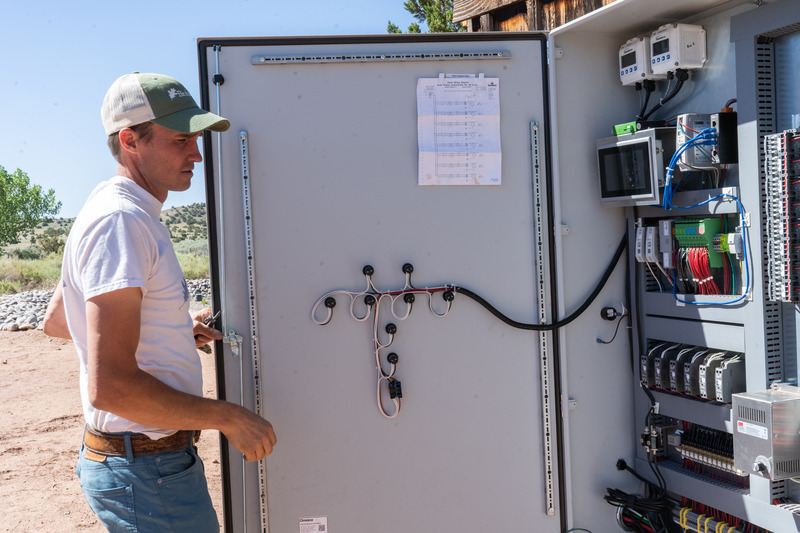
Infrastructure is expensive to build… and operating it year after year is a significant portion of a systems life cycle cost. Manpower to operate decentralized systems, which are often remote and require significant travel time is costly. Paying for sophisticated controls with remote access upfront gives owners, operators, and technical advisors the ability to see how the system is performing in real time. This allows for troubleshooting quickly without expense travel and diagnosis. Telemetry controls also give everyone the ability to review collect and analyze data and review trends in seconds with a touch of a button. The days of manual data collection and only paper logs are numbered.
Other first-time expenses that are worth considering are constructed wetland leak detection systems, built-in ladders and platforms so that operators limit the time, equipment, and number of personal needed to complete a task. Duplex pump systems can provide redundancy that reduce system downtown and the need for operators to perform 24-hour emergency service, which can be extremely expense.
Design for flexibility, expansion, or permit renewal
A little bit of thought and expense to include expansion or upgrade potential can pay large dividends down the road. It can be as simple as adding a union in a pipe network or a tee and stubout for the expansion of a wetland distribution or dispersal system. Including additional conduit and electrical capacity in control panels can also be valuable for long term system potential.
Constructed wetlands are usually built in pairs so that one part of the system can be utilized when part of the system needs to be down for maintenance or repair. At some point, gravel may need to be replaced,so ensuring there is good access to remove and replace gravel is critical for long-term success.