From the Shoreline to Sustainable Waters: My Journey with Constructed Wetlands
By Nicholas Miwornunyuie, Ph.D.
Nicholas Christos Miwornunyuie is an environmental engineer and Postdoctoral Scholar at Morgan State University, with expertise in sustainable water and wastewater treatment, emerging contaminants, and resilient infrastructure. His research focuses on developing innovative and nature-based solutions for environmental protection and sustainable communities. Nicholas was a member of Biohabitats’ 2026 cohort of Interdisciplinary Internship cohort.

Growing up in Jamestown, a historic fishing community along the coast of Accra, Ghana, water was an inseparable part of my childhood. Home was only a short walk from the Atlantic Ocean, where the sea shaped the rhythm of everyday life. Close to the shoreline was a lagoon, and much of my childhood was spent outdoors, playing soccer with friends along the coast, watching fishermen prepare their nets and return with their daily catch, and experiencing the vibrant culture of a community whose identity was deeply connected to water. Yet alongside these cherished memories was another reality that I encountered almost every day.
At one end of the coastline, away from the main fishing activities, I frequently watched sewage tanker trucks arrive and discharge sewage waste directly into the sea. As a young boy, I did not fully understand the environmental or public health implications of what I was witnessing. I simply wondered why the same ocean that sustained our community could also become a place where sewage waste was discarded. Those moments stayed with me and quietly planted the first seeds of a question that would follow me into my career: How can sewage and wastewater be managed in ways that protect both people and the environment?
Fortunately, the story of Jamestown is not the same today as it was when I was growing up. Although many of the practices I witnessed as a child have changed, environmental challenges remain. Looking back, I now realize that those childhood observations along the shoreline were my first lessons in environmental engineering. They planted a curiosity in me about how we could manage sewage and protect the water resources that communities depend upon. That curiosity eventually led me to environmental engineering, where I discovered the transformative potential of nature-based solutions. Among the many technologies I encountered, constructed wetlands immediately captured my imagination.
The first time I truly understood how a constructed wetland functioned, I was struck by its elegance and simplicity. Rather than depending solely on mechanical equipment and energy-intensive processes, it relied on plants, microorganisms, engineered media, and natural ecological interactions to improve water quality. It changed the way I viewed engineering. I began to realize that innovation is not always about building something entirely new. Sometimes, it is about understanding how nature works and designing systems that allow those natural processes to perform at their best.
As my academic journey progressed, my interest in constructed wetlands evolved from appreciation to innovation. During my doctoral research, I explored how these systems could become more efficient, resilient, and sustainable. One project focused on a solar-assisted plug-flow constructed wetland for wastewater treatment, where I explored how renewable energy and improved hydraulic design could reduce operational energy demands while maintaining effective treatment. That work led me to another question: Could a constructed wetland do more than treat wastewater? Could it also help recover energy?
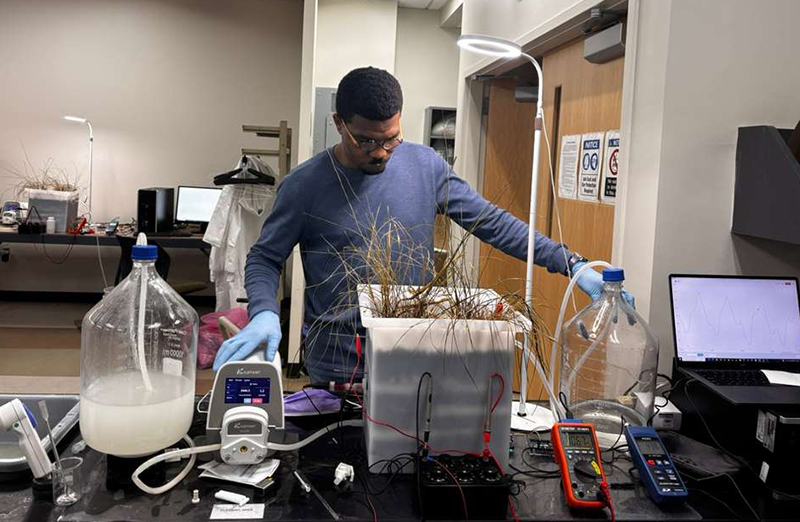
This question led to my work developing a multi-anode plug-flow constructed wetland–microbial fuel cell system. The system combined the natural treatment processes of a constructed wetland with microbial fuel cell technology to treat high-strength wastewater while recovering electrical energy. I became fascinated by the possibility that microorganisms already working within a treatment system could also contribute to energy recovery. These experiences fundamentally changed the way I think about constructed wetlands. I no longer see them simply as wastewater treatment systems. I see them as living infrastructure capable of delivering multiple benefits at the same time, improving water quality, recovering resources, reducing energy demands, supporting ecosystems, and contributing to more resilient communities.
My curiosity about what these systems can do continues to grow. Today, I am particularly interested in their potential to address emerging contaminants such as PFAS and microplastics. These contaminants present new environmental challenges and raise important questions about how existing treatment technologies can be adapted to protect water resources. I look forward to exploring how engineered constructed wetland systems can be further developed and optimized to help address these emerging challenges.
For me, this represents another step in the evolution of constructed wetlands, from systems designed primarily to address conventional pollutants to more versatile living infrastructure capable of responding to some of the newer environmental challenges facing our communities. I am excited by the possibility of bringing together plants, microorganisms, engineered media, renewable energy, and thoughtful system design to create treatment systems that work more closely with nature.
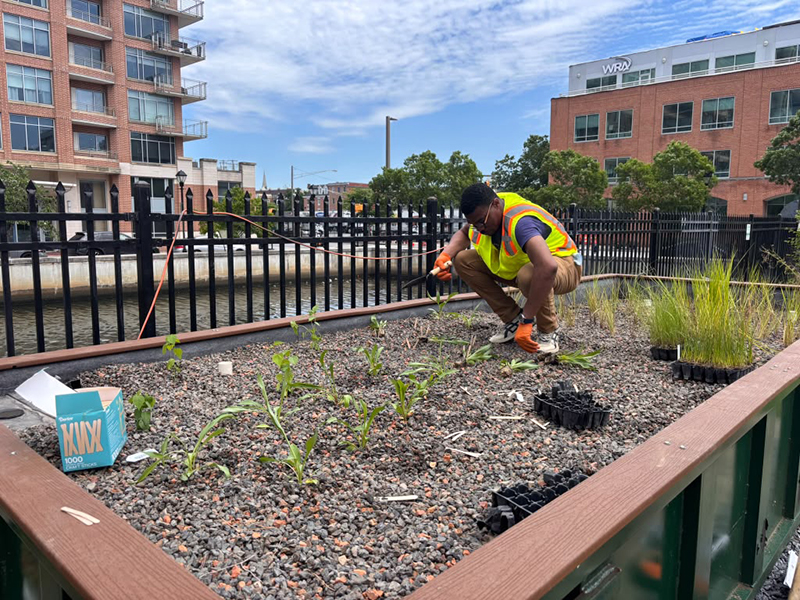
When I think about constructed wetlands today, I sometimes think back to the shoreline in Jamestown. As a child, I saw sewage waste being taken to the ocean as a problem that needed somewhere to go. Today, I think about how we can design systems that treat contaminated water, use fewer resources, recover value, and protect the natural environments that communities depend upon. What began as the quiet observations of a young boy along the Atlantic coast has grown into a career dedicated to protecting water through engineering inspired by nature. For me, constructed wetlands represent more than a research topic. They represent the possibility that some of our most meaningful engineering solutions can emerge when we work with nature rather than against it. And I believe their story is far from finished.