Constructed Wetlands: An Overview
By Annie Berg
When was the last time you thought about where your wastewater went? Now when was the last time you had a morning cup of coffee?

Even something as simple as one’s daily coffee has a water footprint, especially when you consider the water that nourished the coffee plant, the water used in processing, packaging, and brewing the coffee, and the literal waste stream we generate after drinking it. Unfortunately, this wastewater, along with the other wastewater we humans generate, is often collected and managed by aging infrastructure that threatens our environment. What if instead, we learned from nature and created systems that improve our surroundings instead of harming them. Could we have beautiful systems that not only treat our wastewater, but also sequester carbon, add habitat, reduce heat island effects, improve air quality, and more? Oh wait, we already do.
Designed to mimic the natural functions of wetlands, constructed treatment wetlands are a robust, nature-based solution that improves water quality before it is released into the environment. Whether they are treating water from our household drains, wastewater from industrial sites, or stormwater runoff, constructed wetlands use the same processes found in natural wetlands to reduce, remove, and/or reuse pollutants, and improve water quality. An environmentally friendly, cost-effective, and low energy alternative and/or companion to conventional wastewater treatment systems, constructed wetlands provide benefits beyond water treatment. They also help mitigate the impacts of urbanization, improve sustainability and resilience, and function as wildlife sanctuaries and recreational parks.

How did we start using constructed wetlands? Back in the 1950s, German botanist Käthe Seidel, dubbed the “Mother of Constructed Wetlands,” was the first researcher to incorporate vegetation into wastewater treatment wetlands. Although her work inspired for many people in the field of ecological design, including biologist John Todd, it was not always appreciated. The use of plants in the field of science was often dismissed by her biologist colleagues. But that didn’t stop Seidel, and in the end, she changed the field of constructed wetlands forever.
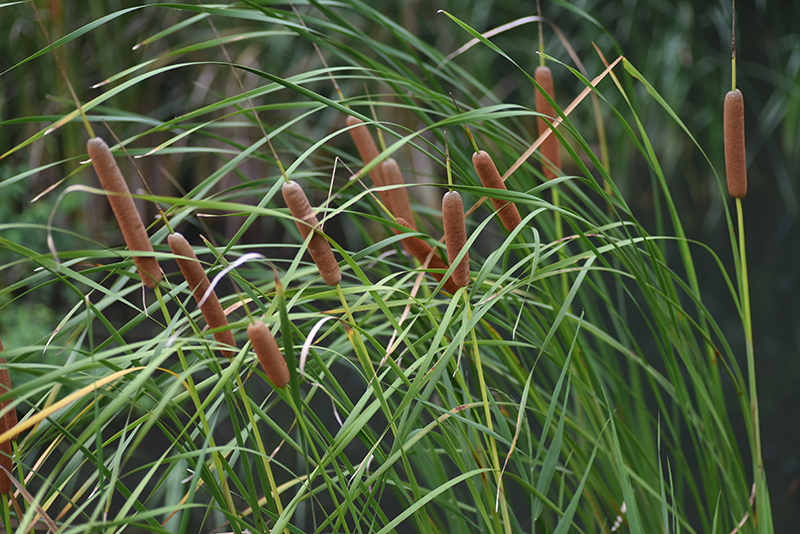
With a lifelong interest in plants and their strengths, Seidel often observed their work in natural waters. When she took these observations to the waters around industrial sites, Seidel realized the water was cleaner and the fish were healthier when common bulrush (Typha latifolia) was present. She began to conduct experiments on the use of marsh vegetation to improve water quality, and found that E. coli, coliform bacteria, and salmonella all disappeared completely over the course of one day when bulrush was present, while healthy bacteria populations increased.
It was generally assumed at the time that higher flowering plants, including such rushes, could only exist in non-polluted waters, yet Seidel’s work directly challenged this thinking. She demonstrated that many plants could adapt to changing conditions of pollution, as well as other extreme water conditions. Over the course of her career, Seidel published many studies about the treatment of wastewater using wetland plants. Her research eventually led to applied ecology projects with constructed wetlands around the world.
Significant growth in the US occurred in the 1980s and 1990s with supportive agencies like the EPA funding several pilots, studies, and publications. During that time many international conferences with a special focus on constructed wetland technology were held in Europe, Asia, Australia, and both North and South America. Organized under the umbrella of the International Water Association, these conferences culminated in major breakthroughs for constructed wetland technology around the world. Constructed wetlands became a “certified” method for wastewater treatment in many countries in the 21st century. The International Water Association, the American Ecological Engineering Society, and the Intergovernmental Science-Policy Platform on Biodiversity and Ecosystem Services all continue to host conferences that discuss innovations and research in the applications of constructed wetlands.
How do constructed wetlands actually work? There are four main processes that improve water quality, including: sedimentation, filtration, microbial degradation, and plant uptake. When water flows into a constructed wetland, it spreads out and slows down, allowing particulate matter to settle at the bottom (sedimentation). Substrate (gravel, sand, etc.) at the bottom of the basin filters out suspended solids as the water flows through (filtration).
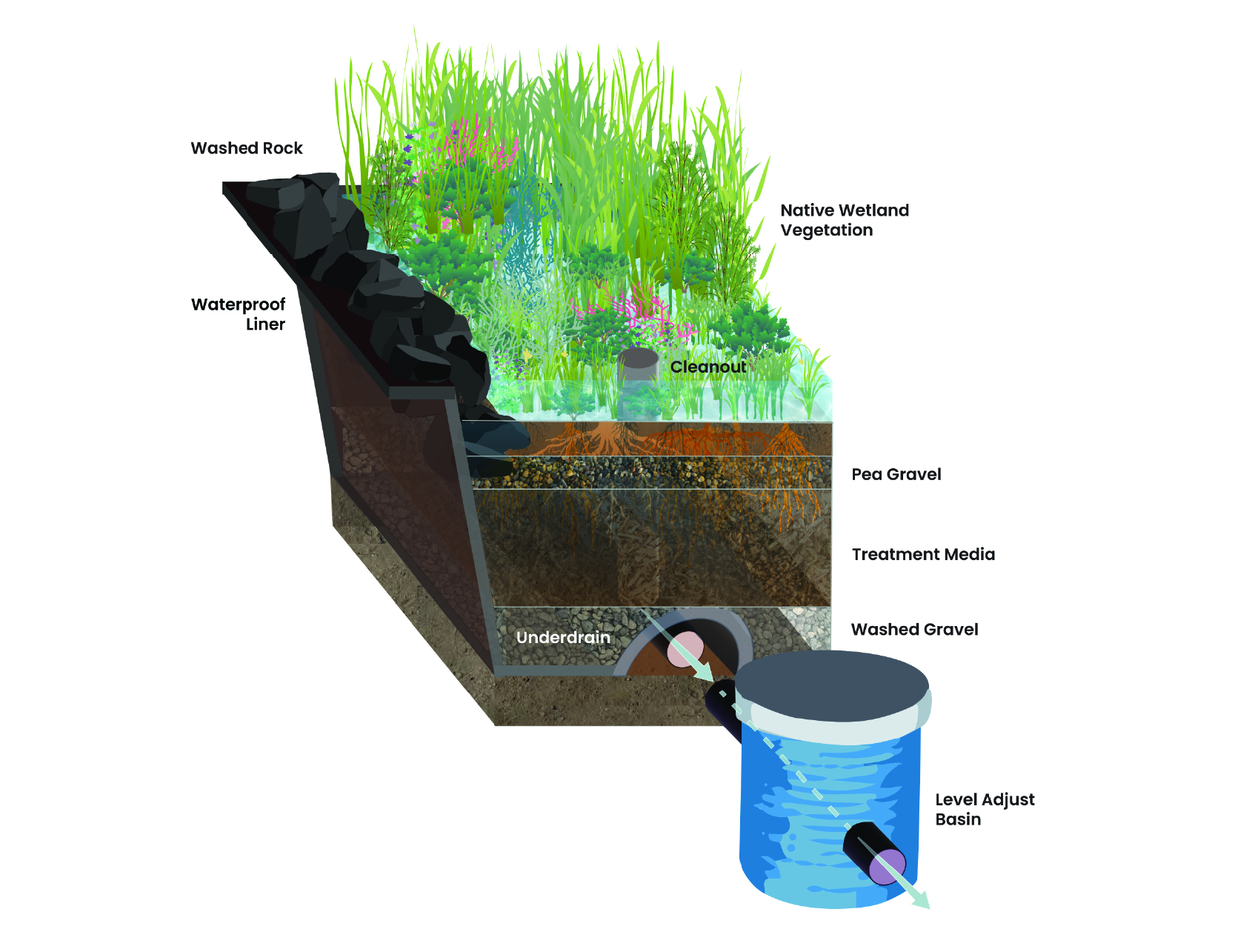
Attached growth microorganisms present in the substrate and root zones cluster to form a biofilm, breaking down and metabolizing organic pollutants (microbial activity). As water flows through the constructed wetland basins, root systems trap sediments, break down pollutants, and absorb nutrients (plant uptake).
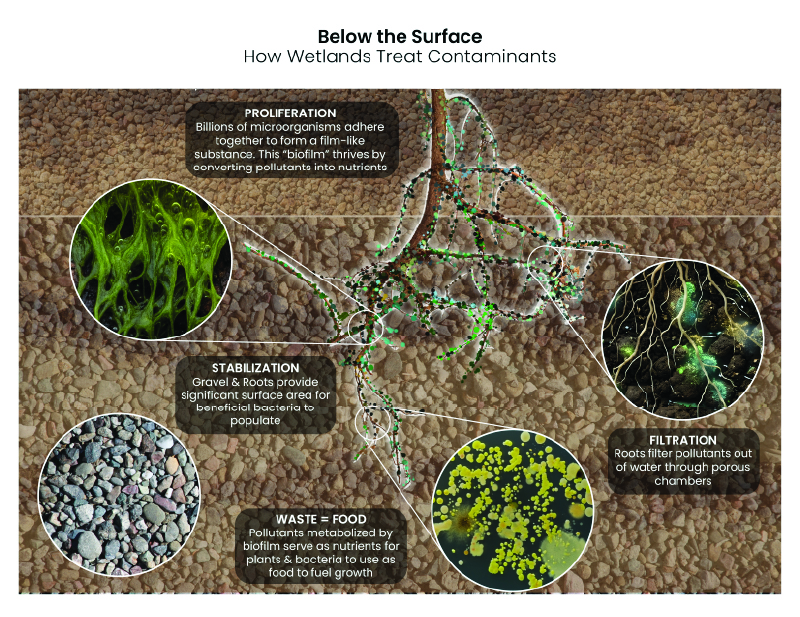
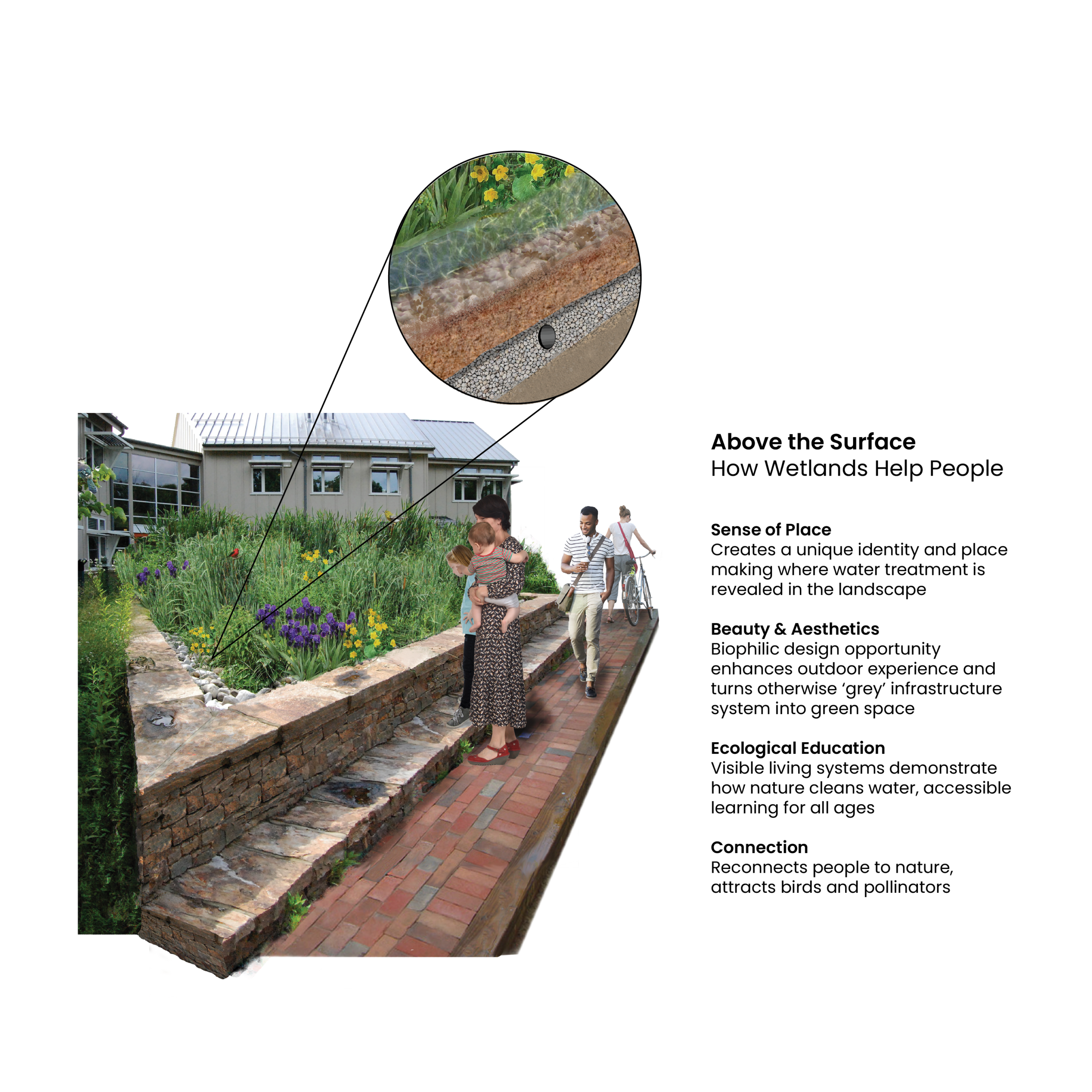
Just as magical below the surface as they are above, these systems have many intriguing elements at play. Open to the environment, with different bacteria arriving based on the kind of wastewater present, these systems are connected to their place, just like a natural wetland, and often require a place-based design. There are many types of constructed wetlands; however, most are classified as either surface flow where you can see the wastewater and subsurface flow where wastewater moves below ground through sand and/or gravel.
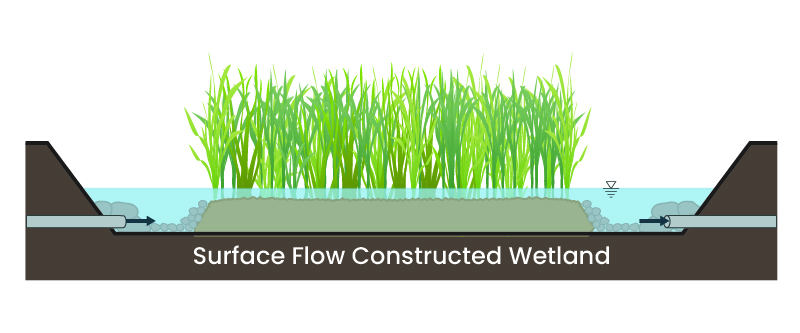
Surface flow constructed wetlands are characterized by shallow basins with emergent vegetation, such as reeds or cattails, planted in a substrate of soil, gravel, or sand. Water enters the wetland at one end and flows horizontally over the surface to the outlet. The shallow depth of the water supports the growth of vegetation, which plays a critical role in filtering and treating the water. These are usually used in larger applications and offer industry or municipal treatment plants a cost effective and relatively easy to construct and maintain component. They are popular choices for communities that are also seeking to create wildlife habitat and enhance landscape aesthetics.
Subsurface constructed wetlands are systems in which water flows below the surface, helping to minimize odors. There are two main types of subsurface flow wetlands: horizontal flow and vertical flow.
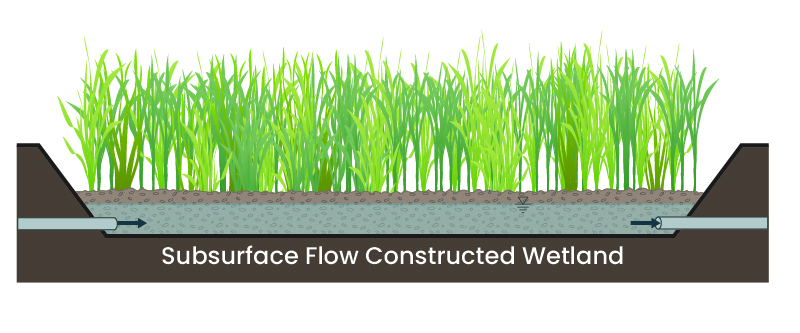
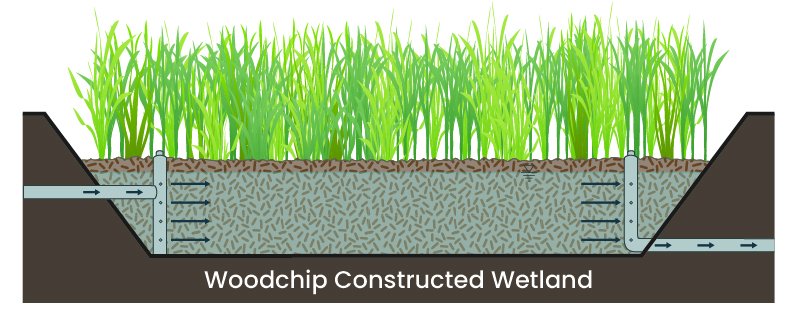
Horizontal flow constructed wetlands involve water flowing horizontally through a porous substrate (such as gravel or sand) that has been planted with wetland vegetation. Water is distributed evenly across the inlet on one side and flows horizontally through the substrate to an outlet on the opposite side. The substrate supports microbial communities that break down pollutants and provide roots with oxygen, while the plants uptake these nutrients. Horizontal flow subsurface constructed wetlands are most effective for removing organic matter, nutrients, and pathogens from wastewater, and are commonly used for treating domestic wastewater, industrial effluent, and contaminated liquids from landfills. These wetlands require careful design to prevent clogging. They may require pretreatment for certain waste streams but are otherwise low maintenance.
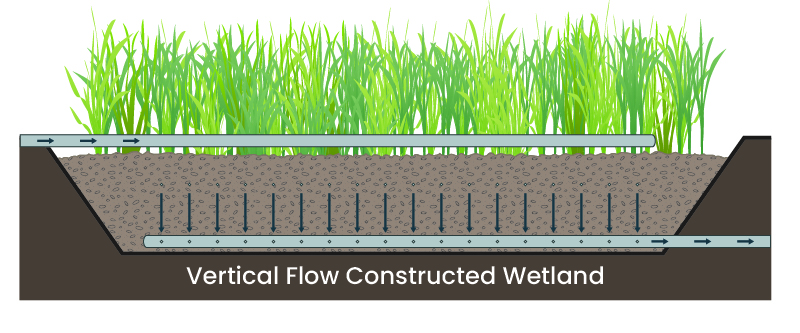
Vertical flow constructed wetlands are designed to have water flow vertically through the substrate, either from the surface down (downflow), or from the bottom up (upflow). In downflow systems, water is distributed over the surface and percolates down through the substrate. In upflow systems, water is pumped from the bottom upwards through the substrate. The vertical flow design enhances the presence of oxygen, promoting microbial activity, and improving pollutant removal.
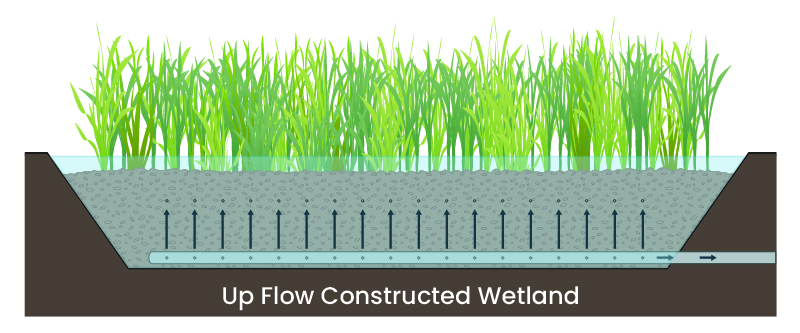
This type is highly effective in removing organic matter, ammonia, and pathogens and is often used for treating domestic wastewater, greywater, and industrial effluent. These wetlands often have a compact design that is suitable for small spaces and high treatment efficiency. They are, however, more complex to design and construct, with upflow systems also requiring energy input for pumping.
There are also hybrid constructed wetlands that combine types to optimize treatment performance and address specific wastewater treatment challenges. They are designed to take advantage of the strengths of each type of wetland, ultimately providing a comprehensive treatment solution. A hybrid system may use a vertical flow for initial treatment of organic matter and ammonia, followed by horizontal flow for further nutrient removal. Hybrid constructed wetland systems offer greater flexibility and can be tailored to meet specific wastewater treatment goals and are suitable for complex wastewater streams with varying contaminant loads. By combining different wetland types, hybrid systems can achieve high levels of treatment efficiency and adapt to changing conditions. They involve a much more complex design and construction process with higher initial costs.
Drain and fill constructed wetlands, which mimic tidal wetlands, are one example of a hybrid system. In natural tidal wetlands, there are periods of complete saturation and others in which the soil is exposed to oxygen. Drain and fill wetlands use pumps to create that tidal flow action. These systems work well for multiple types of treatment as different conditions can be created. When the wetland is completely saturated, it is low on oxygen, but when it drains, oxygen can connect with all the bacterial biofilms, creating a more effective treatment. These systems have been useful in aquarium exhibits to treat aquatic waste before the water is then returned to the system.
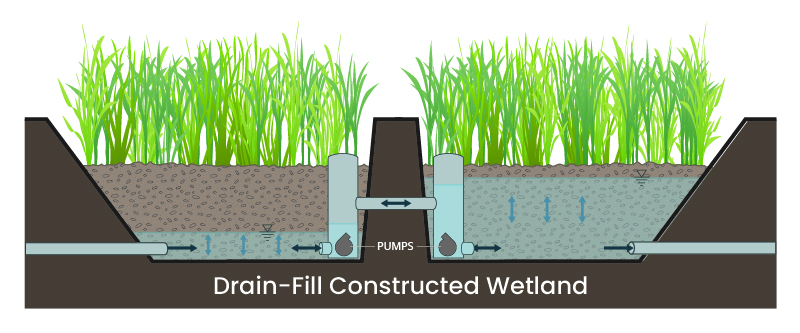
While constructed wetlands were originally created to treat wastewater, they are truly versatile. Substrate, design, and flow regime can all be customized to completely align with project needs. The type and volume of wastewater, the desired treatment outcomes, as well as regulatory requirements, climate, space, and topography can all have a part to play in considering the correct design for a constructed wetland. There are also opportunities to continue testing experimental designs and substrates to move beyond some of the limitations of the surface and subsurface flow wetlands. Using substrates like woodchips or biochar could make better use of resources, while also diminishing cost.
Constructed wetlands provide valuable ecological benefits in regions where water resources are limited due to arid conditions or development and they have become particularly popular in the American Southwest. Places like Arizona are using wetlands as part of an aquifer recharge solution, in which water moves through the treatment wetlands before infiltrating back into the groundwater. There is also the possibility of using constructed wetlands to help protect communities and infrastructure in the face of sea level rise. Many wastewater treatment plants in places like Florida and the San Francisco Bay area are in low lying areas, not far above sea level. Just a foot or two of sea level rise can put critical infrastructure under water. Constructed wetlands can provide storm surge buffers and bring up ground water levels.
A lot has changed since Käthe Seidel discovered that wetland vegetation could naturally clean wastewater. There is now a large and growing body of research and real-world experience related to constructed wetlands, and opportunities to apply this knowledge widely abound. When asked about the future of constructed wetlands, Biohabitats’ Western Strategy Leader and Senior Engineer, Erin English said, “I think they’re a tremendous opportunity for how we as a society can choose to clean our water.”
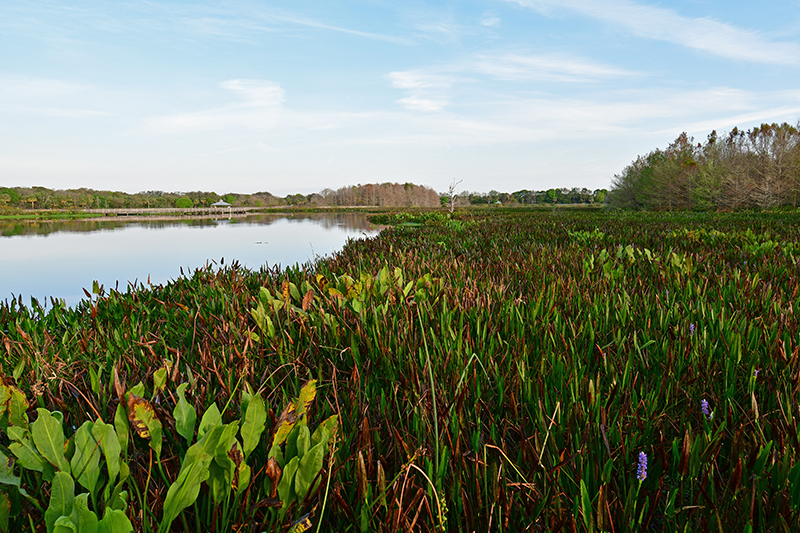
Now, think back to the wastewater from your morning coffee, and imagine a gorgeous constructed wetland park with boardwalks and habitat viewing areas. Not only is it a scenic recreational spot, but every ounce of wastewater is now being cleaned before it is returned to the environment. They might not be a part of your coffee routine yet, but these wetland parks can be found around the world. So, get out and explore one near you (after you finish Leaf Litter of course).