This material was originally presented at the Landscape Architecture Foundation (LAF) Future Now Summit in the summer of 2026. With permission from the LAF, we are honored to share the words of Biohabitats’ Senior Landscape Architect & Urban Ecologist, Aiman Duckworth. A video of Aiman’s talk appears below the text. We hope that Aiman’s proposition and message resonate deeply in your heart—on Indigenous Peoples Day, and on every day.
Rimaykullaykichis. Greetings. I speak to you politely.
I am Aiman Duckworth. I am a father. A life partner. A son. A landscape architect. An ecologist. A mentor. A lifelong student.
And I am a son and grandson of the Runakuna, also known as the Quechua— Indigenous peoples of the Andes mountains.
And of settler peoples in this hemisphere originally from Europe: Iberians, Saxons, Celts, and Polanie.
I give thanks to this land of Waawiyatanong, “where the river bends.” The host nations of this land: Ojibwe, Odawa, Bodéwadmi, Wendat.
And I give thanks to be here with you all today.
Proposition
I am here today with seeds.
These seeds are some thoughts and some questions for us all to reflect on together.
And if some of them resonate in any of your hearts, for you to decide how and where to plant them.
Conditions
We speak of Biodiversity loss. Climate change. Rampant and entrenched inequities.
We are interrogating our role in these wicked problems in our generations, perhaps to an extent never seen before in this young but also ancient profession we call landscape architecture.
We are digging into our toolbox with tremendous and admirable dedication, and cleverness, and innovation.
But we will not just plan, or design, or engineer, or science, or art our way through these conditions to a different future. We must relation our way there.
We must open to the possibility that the problems themselves are often embedded in our solutions. That they may be locked together in the same system.
And while we do indeed need action. We also need to pause. And breathe in the air and song and life of this Earth.
And ask: What is the nature of the relationships that this profession rests on? That our firms rest on? That our universities and education rest on?
Who is what we do for? And whose voices are not being heard or even spoken to?
What do the troubles of our times need from us? Have we really asked them?
Connections
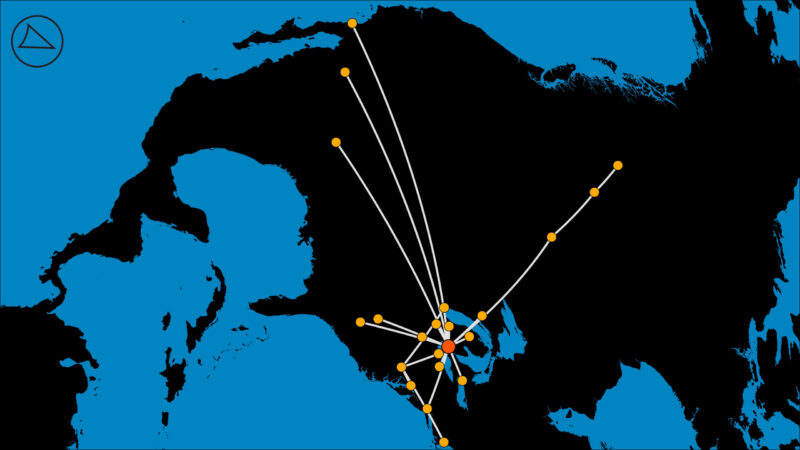
A project here in Detroit may have plants, soil, stone, concrete, wood, metal, manufactured items from across this continent.
Traveling on roads and rail with little to no regard for the trails and routes of other species.
Fueled by oil and rare earth minerals from perhaps the other side of the planet.
A project team may be meeting online from different cities with the bits of our conversation in a data center near the Chesapeake.
And we are beginning to trace the threads of extraction, to follow these trails, and tally the carbon, and the materials, and the distance traveled, and our native plantings.
But do we know the communities and the songs of these other places? Or what songs were silenced?
The life we may be trading there, maybe without ever thinking about it, for the life we drew and designed and assembled here, for our solution, where we want it to be.
Even if we tighten this up to a bioregionalism, every project is really many places at the same time.
Land use, plant palettes, products, materials, resources, ecosystem services — for who?
Imagine we knew those other places? And what they need there? Sat with them? Listened?
Imagine biodiversity and resilience in our work that is more than a layer on top of what we need and want?
Imagine environmental justice for all life? Imagine we gave thanks?
Pachamama

In Quechua we say Pachamama.
Pacha is “world” that includes the dimensions of space and time.
Mama is “mother.” The word “ma” and “mama” is found in languages throughout the world. A word from the deep time of humanity that may be one of the earliest of human words.
So Pachamama — World Mother, or Cosmic Mother, or Earth Mother.
She is space and she is time, she is the source of all life, and she is all life.
Ayni
In Quechua, we also say “ayni.”
Ayni means reciprocity.
The animating exchange between humans and all other beings and Pachamama.
Now reciprocity is good advice in any relationship. In our homes. In our studios.
Good advice in our relationship to the rest of the Living Earth.
And good advice in the relationship of our work with human communities and more-than-human communities alike.
Unkuña

In Quechua, life and being and what in English we might call community and nationhood, is not reserved for humans only. Animals, plants, rivers, stones, mountains, fields, winds, rain, lightning, the Living Earth all have beingness. They can teach and heal. And they are our relatives.
Actions of ayni — of reciprocity — are fundamental to right relations with our relatives. That includes what western ecology calls Traditional Ecological Knowledge and all aspects of what anthropology calls culture.
Ayni reciprocity also flows through time. Ancestors, present generations, and those generations to come. Of all forms of life.
And this is not just a metaphor, or poetry, or nature-based solutions, but a vital, tangible, practical reality of what it means to be in kinship with the Living Earth. What it means to be a human being on this planet. And what it means to be in relation and in community.
Kincentric
These lifeways are a gift from my Quechua ancestors. And they are also in relation to the living traditions of numerous other Indigenous peoples on this Earth.
Dr. Enrique Salmon and Dennis Martinez coined the term “kincentric ecology” to translate these Indigenous notions into western understanding.
Not anthropocentric — centering humans. And not just ecocentric — centering life of ecosystems. But kincentric.
Recognizing an extended ecological family, that shares ancestry and kinship. With these interactions enhancing and protecting the ecosystem and biodiversity over time.
That’s not a passive relationship. That’s not just tread softly. That’s active engagement with relatives.
That’s not just rights. That’s responsibilities. To each other.
Anthropology in the 1800’s coined the term “animism” to describe these kinds of lifeways.
In a manner both pejorative and borne out of curiosity.
So if animism is primitive than “inanimism” is what is modern. A world inert.
Genius of Place
In my design education- this was only hinted at once with “Genius of Place” or “Spirit of Place.” From the Latin Genius Loci.
Many of us know this one I think. Ancient Romans had the belief that places had a spirit. And traditions of offerings and respect for those places and spirits.
The icons of the 18th Century English landscape movement, in the Enlightenment tradition of borrowing from the Greeks and Romans, adopted these words. And then to Olmsted and by the late 1990’s of the Gregorian calendar, I’m learning this term in school associated with landscape architecture.
But what wasn’t discussed in that context was that starting in the millennium before, empire and colonization within Europe had violently persecuted Living Earth peoples and lifeways of Europe.
And while Genius of Place may still have much to teach us. It’s been through a real and often ignored trauma.
For the Ancient Greeks and Romans there was certainly a concerning attitude of human exceptionalism, but there was still a certain beingness of place.
Then sailing and marching to these shores, a denial of beingness. Violently. To other communities, human and more-than-human.
Maybe feeling like orphans in a new land.
Placemaking where there was already place.
In design practice today Spirit of Place could often be a synonym for unique or special or contextual.
A thing lifeless, or without inherent right or agency, can still be unique.
Conclusion
In Quechua tradition, the past is actually seen as being in front of us. The past is known. The past teaches.
We aren’t racing forward to the future. The future is actually behind us. The future is not yet known. The future flows to us.
So Future Now. Yes. I understand the urgency.
But just as urgent might be Ancestors Now.
At some point in all of our lineages, maybe near, maybe quite far away, we didn’t have to ask ourselves Is a River Alive? It wasn’t a novel question. It was a practical and sustaining reality.
So what if We Practice as Relatives?
What if we have spent too long estranged from each other and from all of life around us.
And that life is asking us to remember them. To be in relationship. For us to be good ancestors.
How might we walk differently in all of our work?
Tupananchiskama. Urpichay sonqoy.
Until life brings us together again. I thank you.